Mark Zuckerberg, CEO of Meta, has hired three researchers from OpenAI to bolster his company’s work on artificial intelligence. This strategic move aims to guide Meta Platforms through its current AI challenges. The social-media corporation brought aboard Lucas Beyer, Alexander Kolesnikov, and Xiaohua Zhai, all of whom previously held positions at OpenAI’s branch in Zurich, as per sources privy to this information. These individuals established OpenAI’s location in Zurich towards the end of last year. Prior to their time at OpenAI, they collaborated closely within Google DeepMind, which is the organization’s artificial intelligence division. A representative from OpenAI verified that the three scientists have departed from the organization. Zuckerberg has been on an intense recruiting drive To correct the company’s AI initiatives following the underwhelming reception of its most recent model, he has sometimes proposed giving researchers up to $100 million to become part o...
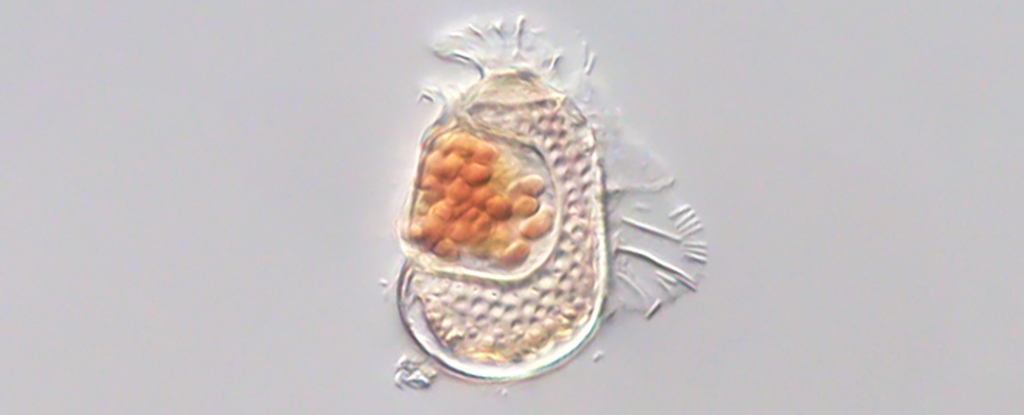
Inside a small plankton, researchers have discovered an even tinier cell leading an unusually virus-like lifestyle, challenging What does it mean to be alive? .
The boundary separating living entities from non-living ones has historically controversially been drawn before viruses , and the recently uncovered microorganism, temporarily called Sukunaarchaeum mirabile, hovers very closely to it.
Ryo Harada, a genomicist from Dalhousie University, and his team inadvertently discovered an unusual parasite when they were attempting to catalogue the DNA of various plankton species. Citharistes regius and its symbiotic bacteria.
A peculiar, minuscule loop of genetic material indicated the existence of an additional entity — something that did not easily classify into recognized groups.
The researchers suggest that Sukunaarchaeum might be the most cell-like entity found so far that adopts a viral approach to existence, write in their paper .
Such extreme specialization tests our basic comprehension of the essential needs for cellular existence.
Related: Thousands of Enigmatic Large Viruses Found Hidden in the Sea
Sukunaarchaeum only has 238,000 base pairs of DNA, yet some viruses reach 735,000 base pairs or even 2.5 million .
Similar to viruses, Sukunaarchaeum entrusts the majority of its biological processes, such as metabolism, to its host. Additionally, much like viruses, the bulk of the cellular genetic material is devoted solely to self-replication.
"The genome is highly minimized, missing almost all identifiable metabolic processes, and mainly coding for the mechanisms of its replication center," stated Harada and her team. explain .
This implies an unparalleled degree of metabolic reliance on a host, challenging the functional differences between basic cellular organisms and viruses.
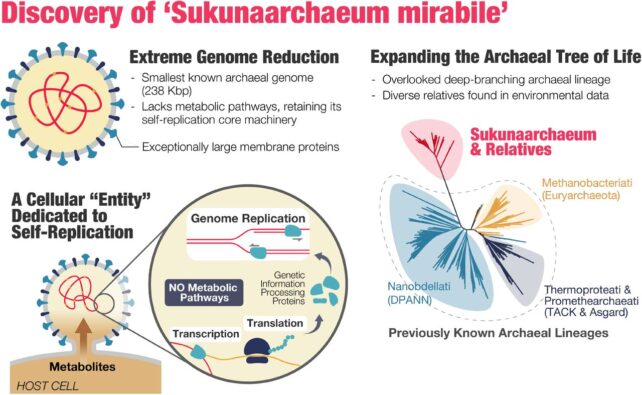
Unlike viruses, which rely on host cells for reproduction, Sukunaarchaeum retains the genetic ability to produce its own DNA replication proteins, such as ribosomes, mRNA, and tRNA. In contrast, viruses take over the cellular machinery of their hosts for this purpose.
Furthermore, Sukunaarchaeum generates proteins that may play a role in creating a membrane to enclose its small circular DNA, which could assist in its interaction with its plankton host.
Genetic similarities indicate that Sukunaarchaeum falls under the category of archaea , the realm of life from which our group, eukaryotes It has evolved. The circular chromosome is similar to the genetic material found in bacteria and archaea.
Without any genes related to metabolism, Sukunaarchaeum seems to provide nothing in exchange for the biological processes it takes over from the plankton.
Viruses are generally not considered alive in part because they can't replicate or sustain themselves without machinery provided by their host. Sukunaarchaeum can replicate, but not sustain itself, making that line between life and non-life even more precarious.
This study has been uploaded onto bioRxiv and has not been peer-reviewed yet.