Mark Zuckerberg, CEO of Meta, has hired three researchers from OpenAI to bolster his company’s work on artificial intelligence. This strategic move aims to guide Meta Platforms through its current AI challenges. The social-media corporation brought aboard Lucas Beyer, Alexander Kolesnikov, and Xiaohua Zhai, all of whom previously held positions at OpenAI’s branch in Zurich, as per sources privy to this information. These individuals established OpenAI’s location in Zurich towards the end of last year. Prior to their time at OpenAI, they collaborated closely within Google DeepMind, which is the organization’s artificial intelligence division. A representative from OpenAI verified that the three scientists have departed from the organization. Zuckerberg has been on an intense recruiting drive To correct the company’s AI initiatives following the underwhelming reception of its most recent model, he has sometimes proposed giving researchers up to $100 million to become part o...
Key Takeaways
- Oil prices rocketed to their highest level in five months early Monday following U.S. attacks on Iranian nuclear sites over the weekend; however, they plummeted significantly later in the day as hopes emerged that tensions in the Middle East might not escalate further.
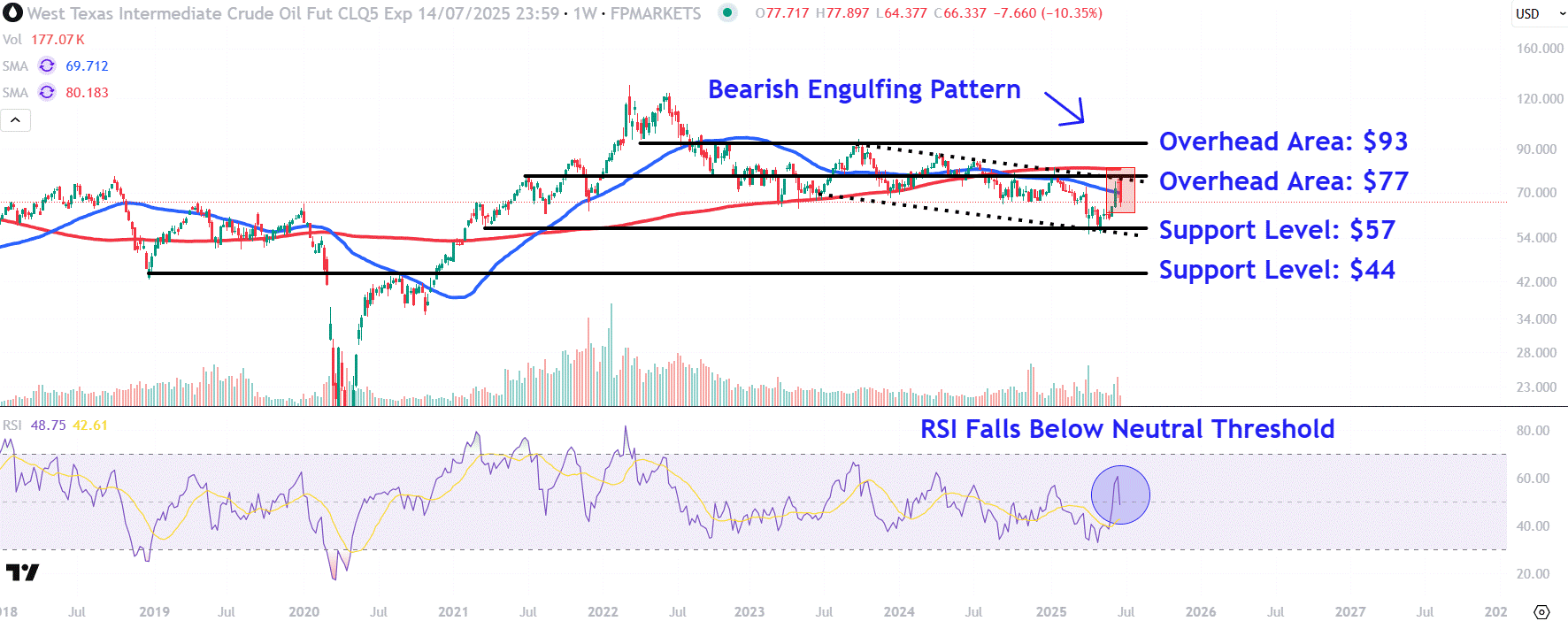
- The commodity's price surged to hit the upper trendline of an extensive downward-channel spanning multiple years during Monday’s trade session, only to experience a significant intra-day turnaround, thus creating a bearish engulfing formation.
- Investors ought to keep an eye on significant support points on the WTI crude chart at approximately $57 and $44, as well as track crucial resistance zones close to $77 and $93.
On Monday, oil prices experienced significant volatility as investors responded to the most recent updates in the Middle Eastern conflict.
West Texas Intermediate futures, which serve as the U.S. standard for crude oil, were hovering just under $67 late Monday. This followed an increase to a five-month peak above $77 per barrel once trading restarted post the U.S.'s attack on three Iranian nuclear sites over the weekend.
Investors expressed concern that escalating conflict might disrupt oil supplies due to potential damage to infrastructure or blockage of shipping lanes, potentially leading to inflation and hampering economic growth. These worries subsided later in the day when Iranian missiles aimed at a U.S. facility in Qatar were shot down, fostering hope that Iran’s reprisal will remain contained and that tension levels in the area may decrease.
Next, we examine the WTI oil more closely. weekly chart and use technical analysis to highlight significant price points worth keeping an eye on.
Bearish Engulfing Pattern Emerges
The commodity's price surged to the upper trendline of a several-year pattern. descending channel during Monday’s trading session, prior to experiencing a significant intra-day turnaround, resulting in bearish engulfing pattern in the process.
The change occurred simultaneously with the relative strength index dropping beneath its neutral level and the price ending up below the 50-week moving average, indicating downward price momentum.
Let’s identify several major support and resistance levels on the WTI chart that traders will probably keep an eye on due to the commodity's recent price swings.
Key Support Levels to Monitor
Additional selling might quicken a decline towards $57. Investors could seek out this level. entry points in this region where the commodity is found confluence from the downward sloping channel's bottom line, as seen in last month’s swing low , and the conclusion of a pullback in March 2021.
A decisive breakdown Below this significant technical threshold lies an opportunity for a decline to $44. Value seekers might look for purchasing possibilities around this zone as we approach December 2018. swing low and the August 2020 swing high .
Important Support Levels to Keep an Eye On
Efforts for recovery in the commodity might lead to an increase close to $77. At this price point, there could be resistance due to the top of this week’s bearish engulfing pattern, the upper boundary of the declining channel, as well as several other factors. peaks and troughs on the graph tracing back to July 2021.
Ultimately, purchasing at this level might trigger an upward movement towards $93. Traders dealing with the commodity should consider this possibility. exit points In this area close to the significant event of September 2023 swing high , several countertrend reaches its apex in late 2022 and an earlier retracement low that was established on the chart during the same year.
The remarks, viewpoints, and examinations presented on appstoreofficialidare serve solely as information. Please review our warranty and liability disclaimer for more info.
At the time this article was published, the author did not possess any of the aforementioned securities.
Read the initial article on appstoreofficialid